Overview
Ethical Schoolwear is an online school uniform retailer based in Crossgar, County Down, founded by parent Liam Charlton-Killen. It sells affordable plain and embroidered uniform made only by independently certified, ethical manufacturers, and plants a tree for every order.
The idea grew from Liam's own experience as an adoptive parent. Asking where his children's uniform came from, who made it and why it cost so much, he struggled to get clear answers, so he set up a shop to provide them.
Since launching in January 2023, the business has grown to supply uniform for 18 primary schools and nine nurseries and pre-schools, most of them in County Down, alongside a plain uniform range. More than 2,800 trees have now been planted on behalf of its customers.
The Challenge
School uniform is one of the most widely bought categories of children's clothing, yet its supply chains are rarely visible to the families who pay for it. Much of it is mass-produced from virgin synthetic fibres or conventionally grown cotton, with little information about working conditions, and is discarded once outgrown.
Cost is an equally pressing concern. Research for the Irish League of Credit Unions estimates that Northern Ireland parents of primary pupils spend around £1,363 across the school year, with 71% describing back-to-school costs as a financial burden.
These pressures led to the School Uniforms (Guidelines and Allowances) Act (Northern Ireland) 2026. Its statutory guidelines require school uniform policies from the 2026/27 school year to put affordability first.
Approach
Ethical Schoolwear combines strict supplier standards with affordable pricing, carbon reduction and a commitment to family choice.
- Certified Ethical Suppliers: The shop only stocks manufacturers that are B Corp certified and Ethical Trading Initiative members, pay a living wage, use as much recycled fabric as possible and open their factories to independent SMETA audits. Suppliers are B Corp-certified.
- Lower-Impact Materials: Cotton jumpers and cardigans are made from Better Cotton, and the eco blazer range uses fabric made with recycled plastic bottles.
- Affordable by Design: Branded sweatshirts start from £12.50 and polo shirts from £9.90, showing that ethical production need not price families out.
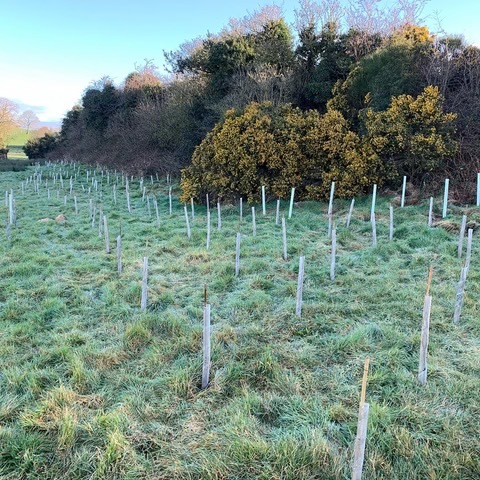
- A Tree for Every Order: Customers can name a sapling, which is planted on a County Down smallholding, a wildlife area recognised by Ulster Wildlife. Since spring 2026, unnamed trees have been planted through Ecologi in areas affected by deforestation.
- Carbon-Neutral Delivery: Emissions from every delivery are calculated and offset through verified carbon removal projects.
- Choice, Not Exclusivity: Ethical Schoolwear never asks schools for exclusive supply contracts, so parents can choose between providers and plain items.
Keeping Uniforms in Use: The Rise of Uniform Swaps
Buying better uniform is only half the picture, the most sustainable item is one that is worn by more than one child. Across Northern Ireland, schools, churches and community groups are increasingly running uniform swaps, setting out tables or rails of clean, pre-loved uniform that parents can pick up throughout the year.
- School-led: Lurgan Junior High School runs a swap shop for pre-loved blazers, shirts and skirts, and has aligned its uniform with feeder and senior schools so items can carry on being worn.
- Church and community-led: The South Belfast Pre-Loved School Uniform Swap Shop is run by Foodstock Open Ormeau, Ballynafeigh Methodist Church and Ballynafeigh Community Development Association.
- Council partnerships: In Ards and North Down, 261 children received pre-loved uniform through pop-up events at Bangor City Church and Newtownards Salvation Army Hub, delivered with Orchardville and ROC NI.
Well-made uniform is what makes these schemes work. Durable garments survive several owners, and plain items or simple, shared designs can be swapped between schools.
Schools or groups thinking of starting one can keep it simple: a regular, visible spot, items sorted by size, an open invitation to take without donating first, and friendly language such as "pre-loved" to help remove any stigma.
Outcome
Ethical Schoolwear shows that a small, rural business can offer families an ethical alternative to conventional uniform at a competitive price. Over 2,800 trees have been planted since launch, and the shop now supplies 27 schools and nurseries alongside its plain range.
By publishing its supplier standards and linking every purchase to a visible action, the business gives parents the answers to questions about origin, working conditions and impact that prompted its founding. Naming a sapling also gives children a tangible link between what they wear and its effect on the world.
Its non-exclusive model helps schools meet the affordability focus of the new statutory guidelines, while durable, hand-me-down-ready garments support the reuse that swap tables make possible.
Why it Matters
School uniform touches almost every household with children in Northern Ireland, making it a powerful everyday route to more sustainable consumption. Ethical Schoolwear demonstrates that fair working conditions, lower-impact materials and affordability can go hand in hand.
Together with the growth of community uniform swaps, it points to a circular model for school clothing: buy fewer, better-made items, keep them in use through hand-me-downs, swaps and repair, and choose suppliers who are open about their impact. Small, local actions like these reduce textile waste, ease pressure on household budgets and strengthen community resilience.