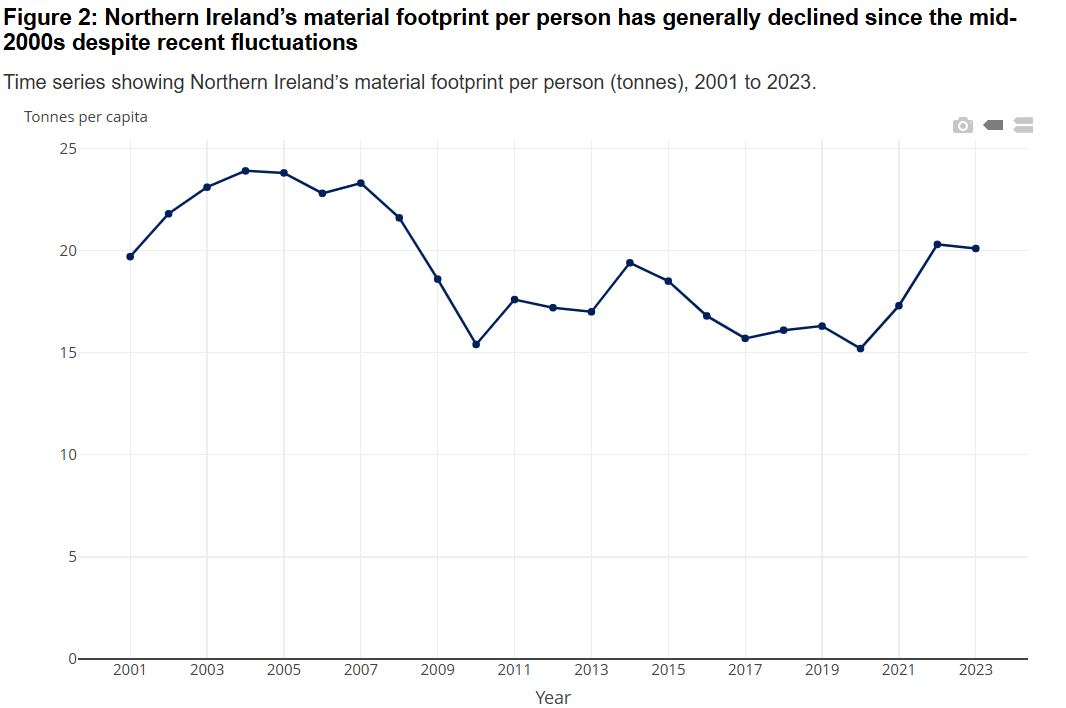
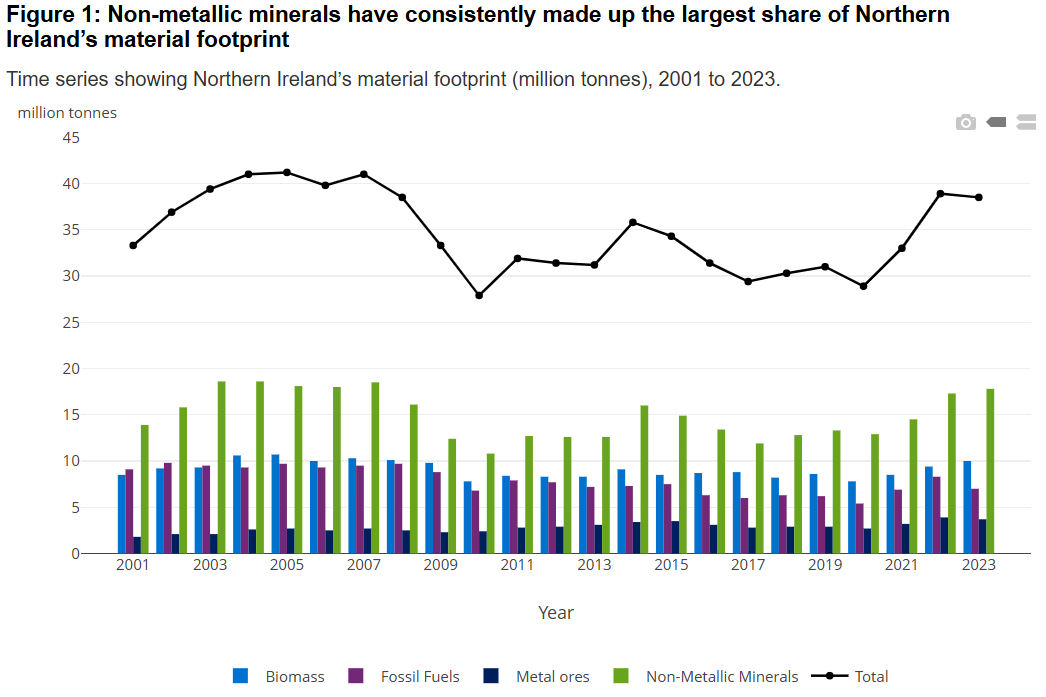
Northern Ireland consumed an estimated 38.5 million tonnes of primary raw materials in 2023, according to new official statistics published by the Department for the Economy.
While total consumption dropped by 0.9% from 38.9 million tonnes in 2022, Northern Ireland's material footprint remains 33% higher than its 2020 low and 15.6% above 2001 levels.
Per-person Consumption Exceeds UK Average
On a per-person basis, Northern Ireland’s footprint stood at 20.1 tonnes in 2023, down slightly from 20.3 tonnes in 2022, but well above the UK-wide average of 17.5 tonnes per person.
The measure captures all raw materials extracted locally, across the UK, and internationally to meet demand for goods and services consumed in Northern Ireland.
Construction Materials Drive Highest Demand
Non-metallic minerals such as sand, gravel, and limestone accounted for the largest share of the footprint at 46%.
Biomass including crops, timber and fish, made up 26%, followed by fossil fuels at 18% and metal ores at 10%.
Environmental analysts note that the heavy share of minerals underscores the critical role played by construction, property refurbishment and infrastructure planning.
Implications for Public and Private Procurement
Policy advisors emphasise that purchasing choices strongly influence environmental impacts beyond direct energy consumption.
To support the draft Circular Economy Strategy's ambition to reduce per-person consumption to 8 tonnes by 2050, official guidance highlights five key procurement measures:
- Setting durability, repairability and upgradeability standards for equipment
- Prioritising refurbished, reused or remanufactured goods were suitable
- Evaluating whole-life costs alongside initial purchase prices
- Requesting supplier commitments on recycled content and product take-back
- Designing construction projects to retain existing site materials
Officials noted that while today's statistics provide a baseline for tracking long-term progress, figures may be revised as underlying methodology updates.