build
Case Study
Case Study

A Community-Led Model for Sustainable Urban Regeneration in Belfast Holylands

A local community transforms neglected alleyways into a safer, greener public space and inspires urban regeneration projects across the city.

Katherine Kelly, Communications & Advisory

Katherine Kelly
Communications & Advisory

Posted

30th Jun, 2026

Length

2 minute read

Type

Case study

Information

place

Location

South Belfast, Holyland (College Park Avenue, Rugby Road and University Avenue)

supervisor_account

Partners

College Park Avenue Residents Association
Queen’s University Belfast

ads_click

Impact Areas

Sustainable Drainage Systems (SuDSs)
Urban Regeneration
Biodiversity
Civic Sustainability


Share

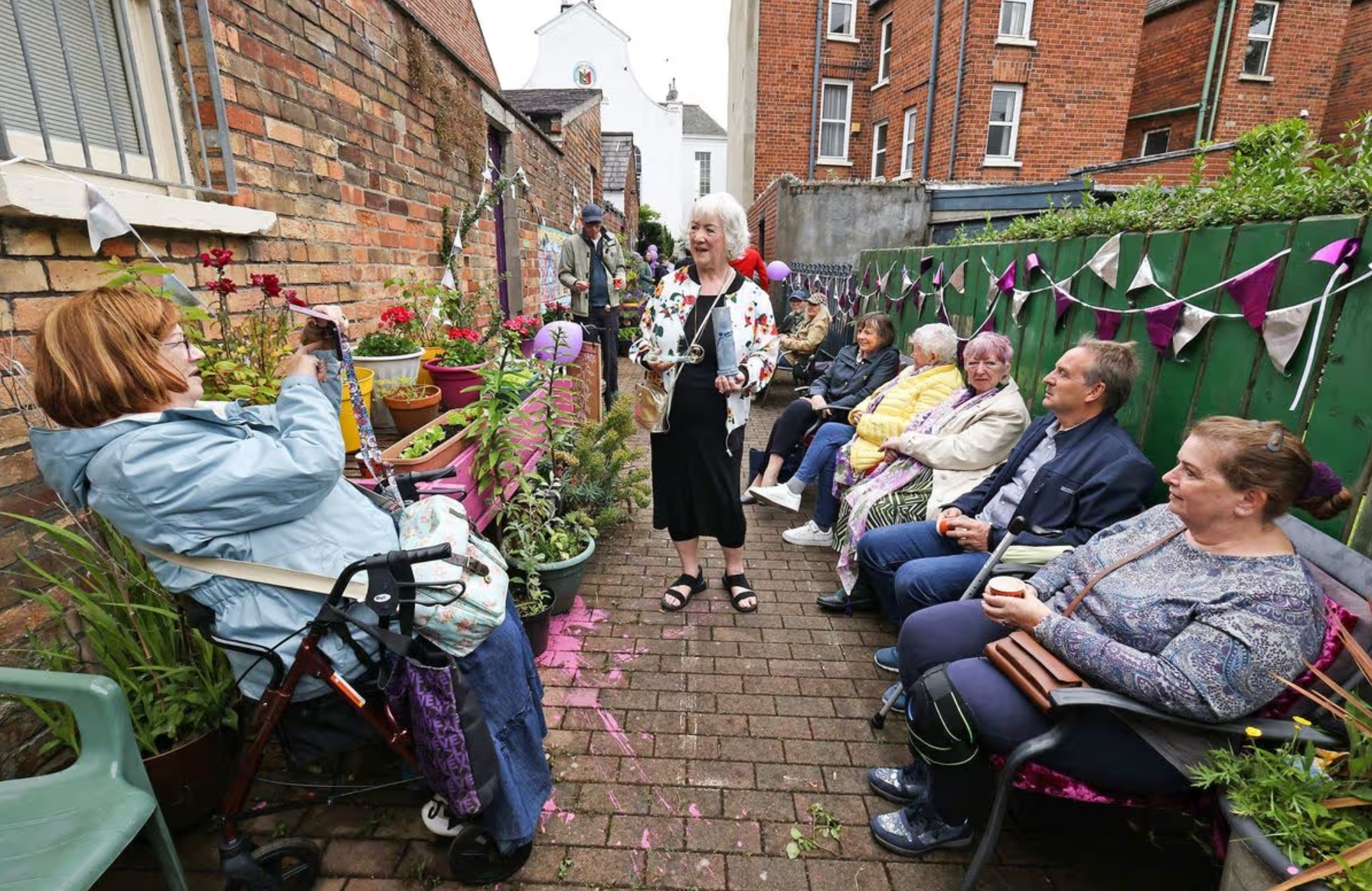
  • Wildflower Alley: Bríd Ruddy (centre), Chair of the College Park Avenue Residents Association. Photo: Justin Kernoghan.
    Wildflower Alley: Bríd Ruddy (centre), Chair of the College Park Avenue Residents Association. Photo: Justin Kernoghan.

Overview 

Launched in 2015, the Wildflower Alley project is a community-led urban regeneration initiative in Belfast's Holylands, that transformed a neglected alleyway into a safe, biodiverse green corridor. 

Led by the College Park Avenue Residents Association, the project was the first of its kind in Belfast and has since inspired around 50 similar green alley projects across the city.

Challenge 

For more than two decades, the alleyways connecting College Park Avenue, Rugby Road and University Avenue were characterised by fly-tipping, vandalism and persistent anti-social behaviour. 

Poor lighting and limited surveillance created spaces that residents avoided.

The deteriorating condition of the area also affected community confidence, leaving a valuable public space underused despite its central location within a densely populated residential neighbourhood.

Approach

The regeneration was led by the College Park Avenue Residents Association through a long-term, community-driven approach.

Residents spent four years campaigning for the installation of alley gates, which were introduced in 2014 to create a secure and manageable space. Drawing inspiration from Green Alley programmes in Chicago and Canada, the community worked with local partners to redesign the space as an attractive green corridor.

Queen's University Belfast supported the project through its Handy Helpers programme, with staff and student volunteers assisting with clean-up activities, planting and ongoing maintenance. Together, residents and volunteers introduced street trees, planting and sustainable urban drainage features that improved both the social and environmental performance of the space.

The project has delivered environmental, social and community benefits, including:

  • Anti-social behavior has fallen significantly, encouraging more families to move back into the street and allowing children to play safely.
  • The space now features new street trees and a sustainable urban drainage surface, improving the area's resilience to heavy rainfall.
  • Improved access to nature for residents, including those with poor health, supporting physical and mental wellbeing.
  • The reclaimed space has become a hub for community gatherings and local events.

Why it matters

Wildflower Alley demonstrates how relatively small, community-led interventions can deliver environmental, social and placemaking benefits simultaneously. By combining urban greening, sustainable drainage, community stewardship and placemaking, the initiative has improved environmental quality while creating a stronger sense of ownership and belonging among residents. 

It also highlights the value of partnerships between local communities, universities and volunteers in delivering practical, place-based solutions.

As towns and cities seek to respond to climate change, biodiversity loss and declining public spaces, the Wildflower Alley project provides an example of how local action can support wider sustainability objectives through low-cost, collaborative regeneration.

Generously supported by:
keyboard_arrow_up